_edited.png)
Top Benefits of Benefits Realization Management for Successful Business Transformation
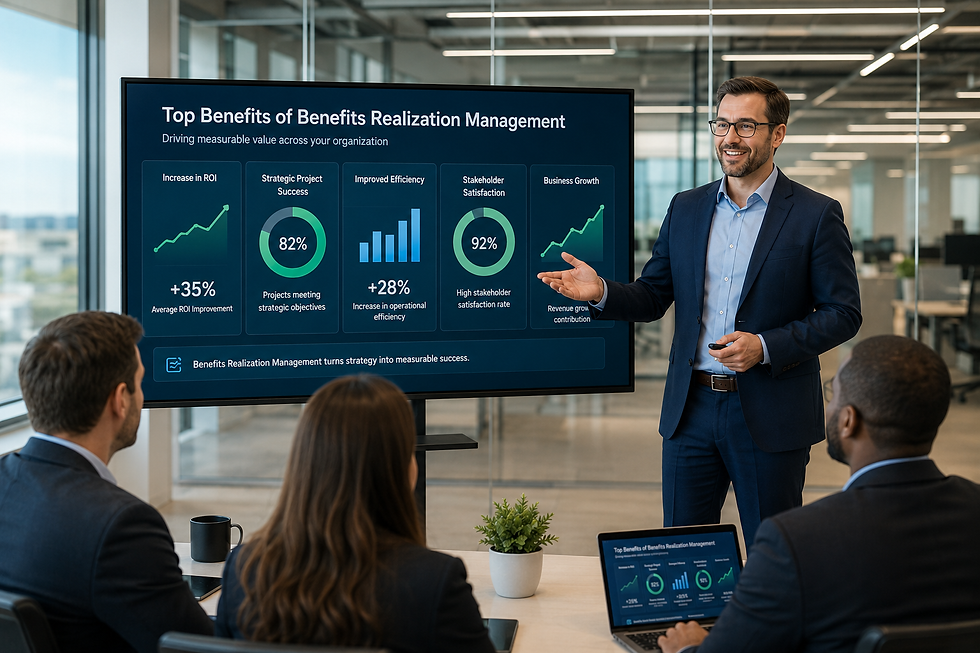
Transforming a business is not simply about introducing new systems, reorganizing departments, or bringing in big capital projects. Transformation is when all initiatives are valuable; they enhance performance and contribute to long-term strategy. Benefits Realization Management provides a framework for organizations to set their expectations for success, monitor progress, manage risk, and ensure investments deliver the value they are expected.
Benefits Realization Management is particularly effective for organizations carrying out intricate EPC projects. Engaging seasoned EPC project management advisors enables leaders to align business goals with actionable steps, thereby evaluating project success not only based on time and budget, but also on overall business impact. Planned, measured, and sustained benefits lead to clearer, more accountable, and more successful transformation.
What Is Benefits Realization Management?
Benefits Realization Management (BRM), also known as benefits management, is a process used to identify, plan, monitor, and maximize the benefits of a project, program, or business change. BRM is not just about output (a finished facility, new platform, or overhauled process); it is about outcomes (growth in revenue, reduced costs, better safety, increased productivity, compliance, customer satisfaction, etc.).
BRM helps implement value in EPC project life cycles from concept development to design, procurement, construction, commissioning and operations in EPC environment.
Benefit 1: Clear Alignment Between Strategy and Execution
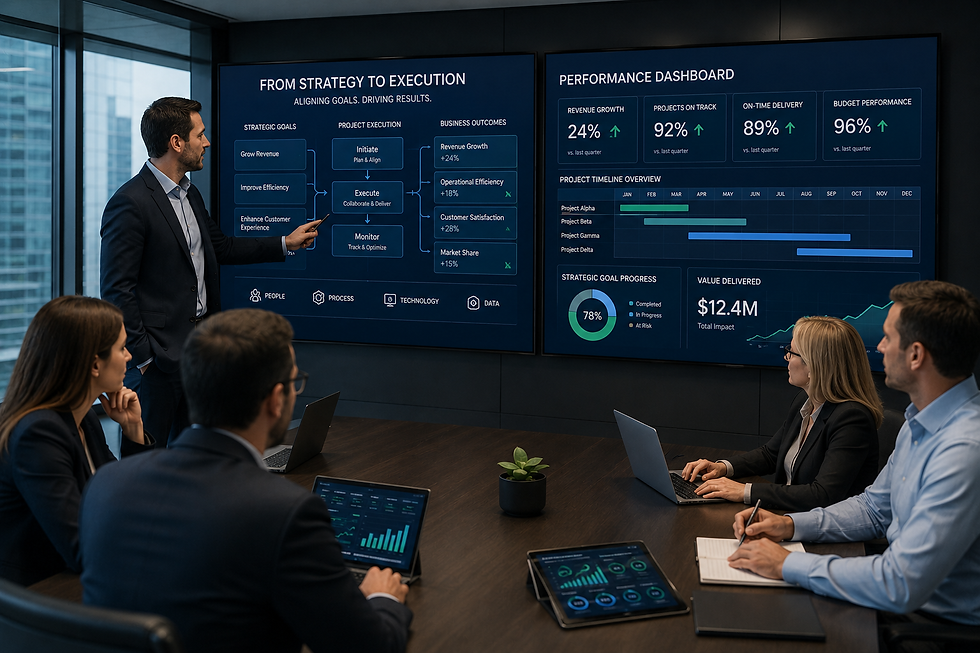
Strategic alignment is one of the top benefits of realization management. Project teams, sponsors, and stakeholders often have disparate ideas of success in many transformation programs. From the start, BRM develops a common understanding of the value.
If an organization adopts the BRM principle, each project objective is associated with a business goal. The upgrading of a processing facility might be linked to an increase in throughput, a decrease in energy consumption, or an improvement in environmental performance. This alignment is crucial with Turnkey EPC solutions since delivery must be for technical and commercial purposes. When each design choice and construction phase directly links to measurable benefits for the team, it enhances the decision-making process.
Benefit 2: Increased Accountability throughout the Organization
Benefits Realization Management has ownership of the expected outcomes. This is a key point, as benefits are not automatically received at the end of a project. They need to be planned, monitored, adopted, and continuously improved. BRM identifies the people that are to be responsible for each benefit and when it should be realized and how it will be measured.
The concept of accountability for project management for EPC can relate to several parties such as owners, contractors, engineers, suppliers, operations teams, and executives. Benefits do not slip through the cracks by having to be responsible in BRM. It also allows leadership to gauge if decisions are in favor of the value case or weaken it. This transparency helps to eliminate confusion and ensures everyone is on the same page and working toward results.

Benefit 3: Better Investment Decisions and Prioritization
Investment is critical for transformation, and organizations need to carefully select initiatives. Benefits Realization Management enhances decision-making by giving a comparison between projects based on expected value, feasibility, risk, and strategic contribution. Rather than approving projects simply because “it feels urgent," leaders can focus their projects on the ones with the best business case.
EPC project management consultants provide ways to review potential benefits before significant capital investments are made. They establish benchmarks for success, validate their assumptions, uncover their dependencies, and challenge their unrealistic projections. This builds a disciplined investment pipeline and enables organizations to focus on investment projects that have the highest return on investment.
Benefits Realization Management has ownership of the expected outcomes. This is a key point, as benefits are not automatically received at the end of a project. They need to be planned, monitored, adopted, and continuously improved. BRM identifies the people that are to be responsible for each benefit and when it should be realized and how it will be measured.
The concept of accountability for project management for EPC can relate to several parties such as owners, contractors, engineers, suppliers, operations teams, and executives. Benefits do not slip through the cracks by having to be responsible in BRM. It also allows leadership to gauge if decisions are in favor of the value case or weaken it. This transparency helps to eliminate confusion and ensures everyone is on the same page and working toward results.
Benefit 4: Improved Risk Management
All change initiatives come with risk. Expenses can increase, timelines can shift, market conditions can change, and stakeholders may resist change. By directly linking risks to expected benefits, BRM can strengthen risk management. Rather than simply asking whether the project is on schedule, organizations can ask whether the projected financial benefits are still attainable.
This translates into managing the benefits and risks throughout the EPC project lifecycle. Design changes can reduce lifecycle efficiency, while delays in procurement packages can impact production startups. Additionally, if an organization lacks a well-defined handover strategy to manage the transition, operations teams may fail to achieve the promised productivity benefits. Identifying these risks early gives organizations the opportunity to take corrective action and prevent loss of value.

Benefit 5: More attention to measurable results
Projects create deliverables, but not all deliverables generate benefits. Benefits Realization Management shifts the focus back to outcomes rather than outputs. It helps teams establish performance metrics before work begins and monitor those metrics throughout and after project delivery.
This end-to-end performance approach enables organizations to stay focused on achieving intended outcomes within a turnkey EPC environment. A turnkey project must not only be installed successfully, but also operate as designed and support the underlying business case. BRM ensures that intended benefits—such as capacity, quality, safety, energy efficiency, maintenance performance, and operational readiness—are properly measured and evaluated.
Benefit 6: Enhanced Stakeholder Engagement
Business transformation involves changes to people, processes, systems, and culture. Even technically successful projects can fail if stakeholder engagement is not properly addressed. BRM helps educate stakeholders about the need for change, the expected benefits, and how they can contribute to the success of the transformation.
In EPC project management, stakeholder engagement may include plant operators, maintenance staff, safety managers, finance teams, regulators, suppliers, and community members. BRM provides a common language for discussing value and enables organizations to communicate progress effectively with different audiences, such as executives focused on ROI and operations teams concerned with reliability.
Benefit 7: Better Change Adoption and Operational Readiness
Although a project may be completed on time, the organization may still not be prepared to use the new capability effectively. Adoption planning, training, process changes, and operational readiness are all key elements of Benefits Realization Management. These components help ensure that the organization can achieve the expected benefits of the project.
EPC project management consultants help bridge the gap between project delivery and operational performance. They may assist in developing readiness assessments, transition plans, training programs, and post-implementation reviews. This approach supports long-term transformation while reducing the risk of underutilized assets, inefficient workflows, and delayed benefits realization.

Partner with Alga Processing LLC for Professional Consulting
Transformation is a process that requires structure, expertise, discipline, and a clear focus on benefits realization. Whether an organization is in the initial planning stage of a new capital project, enhancing governance, or improving operational performance, experienced professionals can help achieve meaningful results.
Alga Processing LLC provides professional consulting services for organizations seeking improved project outcomes, practical implementation support, and value-driven transformation. Effective project management goes beyond simply completing a project—it involves delivering measurable business success through strategic execution and continuous improvement.
Schedule an appointment with Alga Processing LLC to learn how Benefits Realization Management can help your organization achieve long-term strategic value.

Alga Processing LLC is an organization that helps your business in operations and management. Its people come from various backgrounds of knowledge and experience that promote a healthy environment for your personnel. Your organization will benefit from ensuring you and your team members are there every day to give the time and talent to yield productivity to its maximum. Contact us for more information on how to help your business grow.


Comments